Plane on a conveyor belt
-
thrash;199263 wrote:
I am unconvinced. Why do you say that? Suppose that the plane develops only enough thrust to move it forward at 1mph (and never any faster, due to power and aerodynamic reasons not really seen on a real aircraft). Further suppose that the (powered) belt moves backwards with such violence that the plane, due to the friction in the wheels and tires, is going to be pushed back at somethingl like 200 mph. The plane certainly is not going to move forward in this situation.I'm assuming no mechanical failures. I figured that was a given. So long as the plane is capable of getting the plane moving forward on the belt in the first place, it will continue moving it forward, completely unhindered by the belt (barring mechanical failure of bearings) Besides, the belt matches the planes forward speed. Once the static friction of the wheels is overcome, the plane will continue moving forward.
I don't think so. See my point above -- if the belt develops so much reward motion on the plane such that the planes engines, at full thrust, are unable to make forward progress vs the belt, then by the same token, the plane is not making forward motion through the air, and thus, there's no lift, and no liftoff.
This is impossible. Speed has very little to do with the friction of the bearings/wheels. Actually, the faster something spins, the less friction there is (until it becomes unbalanced and starts spinning erratically, causing wobbles and binding at the bearings resulting in overheating and malfunction)
The reason i gave a cautious answer is because i can envision a system of engine output so low and wheel friction so high that the plane, at full throttle, on a powered belt, will either stay stationary or move backwards.
Ok, IF you could have that much friction AND that little power to keep the plane motionless, sure, the plane won't take off. But then it wouldn't take off regularly either.
(tjamz is too lazy to use quote tags)
-
tjamz;199249 wrote:
Posts like this make me want to cry.What part of the riddle makes you think the plane remains stationary?
Please explain to me the physics involved that would be required for a conveyor belt to hold a plane stationary. It is IMPOSSIBLE.
Ok, maybe you are referring to the alternate version of this riddle which states that the conveyor matches wheel speed in the opposite direction.....but wait, the only way to match the wheel speed would be for the conveyor and the plane to be traveling in the same direction (with the conveyor moving at 1/2 the speed of the plane which would mean the wheels would be spinning at 1/2 of their normal rate as well causing the conveyor and the wheels to be matched in speed) which certainly won't stop the plane from taking off either.
In your inline reply with his quote, I think that the word you are looking for is "regardless"
-
I can't believe this topis is still being discussed. LOL
Maybe this will help... lets assume the jet engines are at full thrust, and the conveyor is moving like a mofo and you locked up the brakes on the plane. Would the plane come to a stop on the conveyor, or would the thrust of the engines keep pushing the plane forward just grinding the tires into a smoking pile? Of course it depends on the thrust of the engines, but I'd venture to guess that the majority of planes would continue accelerating even with the wheels locked up. The idea of the conveyor affecting the plane much at all with the brakes off is silly. Yes, there is a small amount of friction in the wheel bearings, but it's negligable.
Example 2: You have a baby stroller with a small jet engine in it, you get on the treadmill with the stroller and start pushing it. You stay in place in relationship to the ground as the treadmill matches your walking pace. You fire up the jet engine... what happens?
DaveH
'94 Supra- 7.77 @ 176mph -
if the conveyer belt is powered externally it is possible to concoct a scenario where the plane doesn't move forward enough, relative to the air, to take off.
Disagreeing with this is foolhardy -- it's the same argument as saying that you don't slow down when trying to swim against a current. A powered belt does counteract the forward motion of the plane, and to what extent depends on the belt and on the construction of the plane.
an externally powered, moving belt, DOES exert a force on the plane, and, in the absence of sufficient force vector opposite in direction, will cause the plane to move backwards. If the thrust of the engines is less than the force of the belt moving the plane backwards, the plane will move backwards.
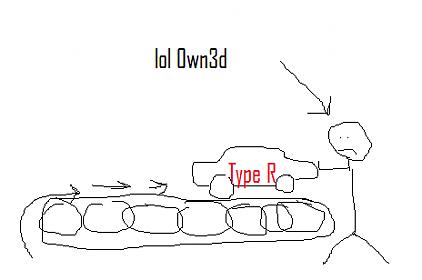
Here's a fun experiment: a car (with tires), with its brakes off and in neutral is on a conveyer belt, rolling backwards. You are at the end of the belt, and behind you is a wall. Your job is to hold the car on the belt. You can use both arms if you want to.
Do you have to exert any effort to keep the car from crushing you? If so, how much?
I welcome anyone that thinks that it doesn't matter what the belt is doing to stand behind the car in my picture

You'll note that i didn't chime in on this thread until people started saying "no matter what, it takes off". I agree that in the problem, as stated, the plane takes off.
However, insofar as someone is willing to make an absolute statement that the plane takes off, irrespective of how the belt is moving or how it is powered, I think they are incorrect.
-
Ok, the plane will NOT take off. A plane needs airlift to take off...and unless the air around the plane and the whole conveyor contraption is moving very fast (fast enough to lift a plane) it will not fly.....now if it was a rocket ship...that would be a different story due to it having rockets.
Info provided by my physics teacher:)
*1989 Nissan 300ZX Z31 *
> DelSlow;262050 wrote:
> I like the new JN210 -
thrash;199273 wrote:
if the conveyer belt is powered externally it is possible to concoct a scenario where the plane doesn't move forward enough, relative to the air, to take off.Only if the plane doesn't operate like a normal plane can the conveyor exert enough force to stop the plane, but in that case, the plane wouldn't take off either way.
Disagreeing with this is foolhardy -- it's the same argument as saying that you don't slow down when trying to swim against a current. A powered belt does counteract the forward motion of the plane, and to what extent depends on the belt and on the construction of the plane.
**
An airboat does not slow down going upstream or downstream in the current, nor does a seaplane.**an externally powered, moving belt, DOES exert a force on the plane, and, in the absence of sufficient force vector opposite in direction, will cause the plane to move backwards. If the thrust of the engines is less than the force of the belt moving the plane backwards, the plane will move backwards.
Again, if the plane has enough power to move forward on a stationary ground, it has enough power to move forward on a belt.
Here's a fun experiment: a car (with tires), with its brakes off and in neutral is on a conveyer belt, rolling backwards. You are at the end of the belt, and behind you is a wall. Your job is to hold the car on the belt. You can use both arms if you want to.
Do you have to exert any effort to keep the car from crushing you? If so, how much?
Yes, but once I get the car stopped from rolling backwards, you can crank that belt up as high as you want and the difference in force required becomes negligible. IOW once I have the car stopped on the belt, it doesn't matter if the belt is moving 5mph or 500mph.
I welcome anyone that thinks that it doesn't matter what the belt is doing to stand behind the car in my picture
You changed the parameters of the question though. The question says the belt matches the planes speed, and once the wheels are rolling, the plane will have no problem maintaining forward momentum.
You'll note that i didn't chime in on this thread until people started saying "no matter what, it takes off". I agree that in the problem, as stated, the plane takes off.
**
It takes off pretty much no matter what......if you have a long enough belt, and large enough fuel cell, you can get that belt moving 300mph prior to firing up the jets and the plane will (in time...has to overcome momentum only) move forward and take off. Also at some point, the wind resistance of being pushed backwards will cause the plane to not move a slowly backwards and start its wheels rolling**However, insofar as someone is willing to make an absolute statement that the plane takes off, irrespective of how the belt is moving or how it is powered, I think they are incorrect.
Sorry, I guess I meant in relation to the riddle...and I clarified my points above.
Clarified for ya
-
JN210;199274 wrote:
Ok, the plane will NOT take off. A plane needs airlift to take off...and unless the air around the plane and the whole conveyor contraption is moving very fast (fast enough to lift a plane) it will not fly.....now if it was a rocket ship...that would be a different story due to it having rockets.Info provided by my physics teacher:)
Your physics teacher should be fired. Period. Feel free to show them my post here, if they have a problem with that statement, they can call me at 701-541-3484. I am dead serious. He/She should be fired.
-
JN210;199274 wrote:
Ok, the plane will NOT take off. A plane needs airlift to take off...and unless the air around the plane and the whole conveyor contraption is moving very fast (fast enough to lift a plane) it will not fly.....now if it was a rocket ship...that would be a different story due to it having rockets.Info provided by my physics teacher:)
that's what makes it a riddle though -- the "Trap" here is to assume the plane remains stationary w.r.t. the ground (and thus the air). Yes, if the plane were driven by its wheels and the belt counteracted that perfectly, there'd be no air movement over the wings, and thus, no lift, and thus, no take off.
However, because it's driven by thrust, and not it's wheels, it will tend to roll forward on the runway like normal. In the case of an undriven belt, the belt is more likely to move with the plane than against it..depending on where the highest/lowest frictional intersections in the system are.
The point i am raising is if the belt is moving the plane backwards via some external power source, then the plane MAY not take off, and it depends on the details of how fast the belt is going, what the wheels are built like, what the takeoff stall speed is, and what kind of thrust the engines develop.
-
tjamz;199277 wrote:
Your physics teacher should be fired. Period. Feel free to show them my post here, if they have a problem with that statement, they can call me at 701-541-3484. I am dead serious. He/She should be fired.woah...easy, I just asked him if it would take off and he simply gave me an answer.
*1989 Nissan 300ZX Z31 *
> DelSlow;262050 wrote:
> I like the new JN210 -
An airboat does not slow down going upstream or downstream in the current, nor does a seaplane
I beleive these statements are both false. You are in effect asserting that fluid dynamics does not exist.
Have you ever been to the lake before? Stand on the dock, hold on to a boat via a peice of rope. Are you saying the rope tension never changes because of waves or currents in the water? Are you saying that no matter what the water is doing, the tension on that rope (and via extension, the force you apply) never changes? I don't think you are...
An external force (you, attached to the land), trying to hold an object still in a moving fluid (air and water are both fluids) will need to vary your supplying force to counteract changes in the force the fluid is applying to the object.
Yes, but once I get the car stopped from rolling backwards, you can crank that belt up as high as you want and the difference in force required becomes negligible. IOW once I have the car stopped on the belt, it doesn't matter if the belt is moving 5mph or 500mph.
I see. In that case, next time someone is doing a 1000hp dyno run, instead of using multiple ratchet straps, why don't you just hold onto the car yourself?
If you were to replace the "you" in that picture with a spring, the spring will slowly compress as the speed increases, because we are talking about an imperfect system with non-zero mechanical losses.
It takes off pretty much no matter what......if you have a long enough belt, and large enough fuel cell, you can get that belt moving 300mph prior to firing up the jets and the plane will (in time...has to overcome momentum only) move forward and take off.
This is incorrect. If for no other reason than there is no ground-launched lift-effect aircraft with a takeoff speed of 300mph. You won't see a plane making 300mph on land during a takeoff run
In any case, suppose the landing gear is a square block. The plane will certainly not take off.
Suppose that the landing gear is a frictionless rolling assembly. The plane will definitely take off.
Reality is somewhere inbetween. That's why you can't make this an absolute statement.
I'm not sure what physical property of aircraft you are referring to such that you can claim that no matter what, given enough time and distance, the plane will accelerate enough to take off.
-
tjamz;199277 wrote:
Your physics teacher should be fired. Period. Feel free to show them my post here, if they have a problem with that statement, they can call me at 701-541-3484. I am dead serious. He/She should be fired.that's probably a bit harsh. A teachers job is to indoctrinate students with government propoganda, not solve riddles
-
thrash;199282 wrote:
I beleive these statements are both false. You are in effect asserting that fluid dynamics does not exist.Have you ever been to the lake before? Stand on the dock, hold on to a boat via a peice of rope. Are you saying the rope tension never changes because of waves or currents in the water? Are you saying that no matter what the water is doing, the tension on that rope (and via extension, the force you apply) never changes? I don't think you are...
An external force (you, attached to the land), trying to hold an object still in a moving fluid (air and water are both fluids) will need to vary your supplying force to counteract changes in the force the fluid is applying to the object.
Ok...I may be off in my assessment here, I was merely going off what was presented to me on phys.org and some pilot forum I was on. The conclusion, on both, was that once the airboat/seaplane were moving, the waters direction & speed had a very minimal affect on whether they could take off (or travel in opposite directions in the case of the airboat which is not designed for flying) or not.
I see. In that case, next time someone is doing a 1000hp dyno run, instead of using multiple ratchet straps, why don't you just hold onto the car yourself?
**
This is a bit different though, in this case the car is pushing the rollers, not vice-versa, so therefore the car is generating the forward motion. See my analogy of a toy car on a belt sander earlier in this thread for reasons why I think I can hold a car from crushing me on a conveyor belt (assuming the car is stationary and in neutral at the start of the test and I don't have to overcome momentum as well)**If you were to replace the "you" in that picture with a spring, the spring will slowly compress as the speed increases, because we are talking about an imperfect system with non-zero mechanical losses.
This is incorrect. If for no other reason than there is no ground-launched lift-effect aircraft with a takeoff speed of 300mph. You won't see a plane making 300mph on land during a takeoff run
I said belt speed, not plane speed. The plane (if its a 747 for example) will take off when it achieves 180mph relative to the ground.
In any case, suppose the landing gear is a square block. The plane will certainly not take off.
If the square block is extremely slippery, it certainly could.
Suppose that the landing gear is a frictionless rolling assembly. The plane will definitely take off.
Assume it has its normal friction and it will as well
Reality is somewhere inbetween. That's why you can't make this an absolute statement.
**I'm pretty sure that just about everyone would agree that the scenario at hand assumes that the aircraft in this riddle is in normal operating condition. Throwing oddball scenarios out there certainly make it possible for it not to take off. Why not say something like "well, what if the plane has 3 engines pushing it forward and 9 engines pushing it backwards and the 3 forward engines only produce 10000 lbs of thrust each and the 9 backwards engines produce 100000000000 lbs of thrust each...can the plane take off?" Of course not. **
I'm not sure what physical property of aircraft you are referring to such that you can claim that no matter what, given enough time and distance, the plane will accelerate enough to take off.
So long as the aircraft can generate enough thrust, in enough space, with enough fuel, to overcome the momentum generated by the plane moving backwards at 300mph, the plane will take off. Every time.
Again...clarified.
As for the original question, the plane will always take off under normal conditions/parameters of the question. There is absolutely nothing that the BELT itself can do to prevent this if it follows rules of the question. The only thing that can prevent the plane from taking off is the plane itself.
-
JN210;199287 wrote:
I think someone should actually try this at home....with an RC gas plane and somekind of belt....just a thought.glad you asked...




Hello! It looks like you're interested in this conversation, but you don't have an account yet.
Getting fed up of having to scroll through the same posts each visit? When you register for an account, you'll always come back to exactly where you were before, and choose to be notified of new replies (either via email, or push notification). You'll also be able to save bookmarks and upvote posts to show your appreciation to other community members.
With your input, this post could be even better 💗
Register Login